Write for a Specific Player
Before writing a single note, decide who the music is for. A piece aimed at a young beginner looks completely different from one designed for a returning adult learner, even if both technically qualify as "beginner" level. Settling this question early keeps your notation consistent from start to finish.
For Beginners
The range is wide. A child just starting out might need note names printed inside the noteheads, hand positions that never span more than a fifth, and a slightly enlarged staff. An adult with limited experience can usually handle more. Before you begin, it's worth thinking through the following questions:
- Whether note names inside noteheads are needed
- Whether the staff size should be larger than standard
- Whether fingering suggestions would help
- Whether to include chord symbols
- Which articulations, if any, to notate
- Whether the player can comfortably read anything faster than eighth notes
- How many simultaneous notes per hand are realistic
- How complex the coordination between hands should be
- What the largest comfortable interval is for this player
- Whether lyrics are included
None of these questions have universal answers. The right choices depend on how clearly you've pictured the person you're writing for.
For Intermediate Players
The considerations shift. Where "beginner" ends and "intermediate" begins is a judgment call, and that's fine. What matters more than the label is which musical elements you choose to bring in. More rhythmic complexity, expressive pedaling, ornaments, detailed chord labeling: each one moves the piece further along the spectrum. Define the level by what's on the page, not by how many years someone has been playing.
Adding Lyrics
Lyrics help beginners connect notation to music they already know, and give any player a reliable landmark when they lose their place. In solo piano music, lyrics go between the two staves. When a piece has multiple verses, limit what you show on the staff — two lines of text is plenty before the staves start drifting too far apart to read comfortably. Extra verses can go at the end of the piece.
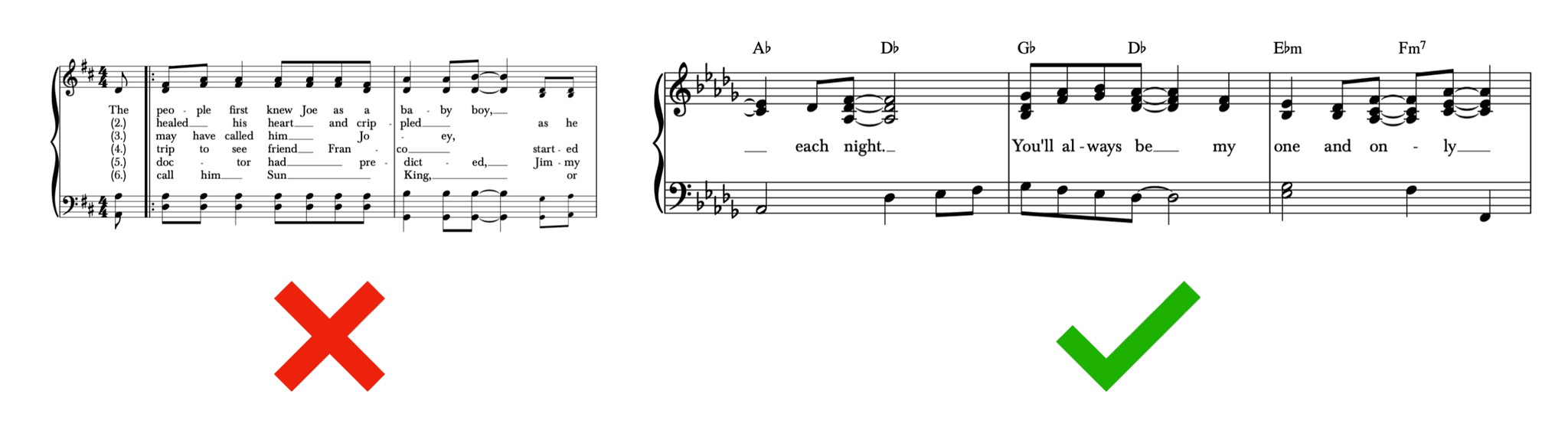
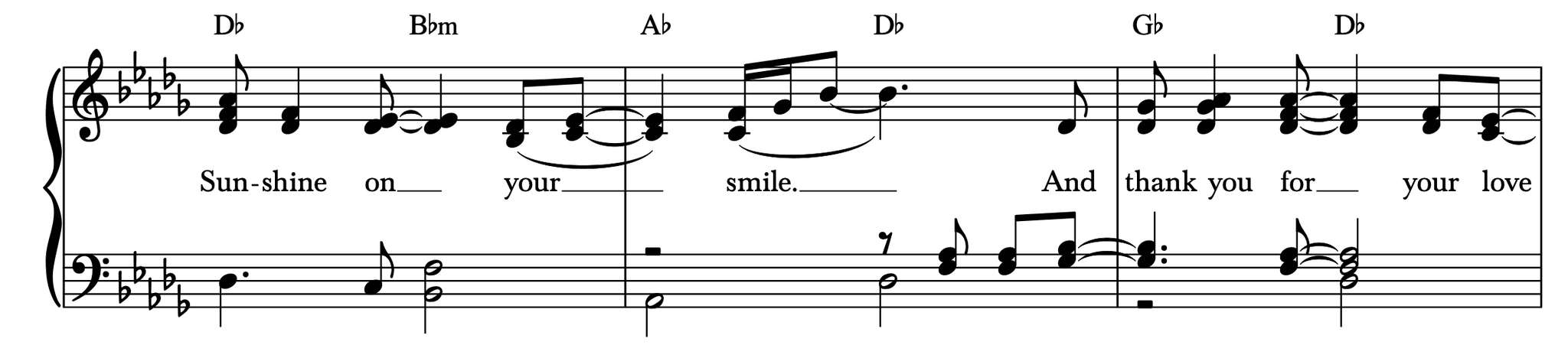
A few conventions to follow:
- When a single syllable carries across multiple notes, add a slur over those notes
- Separate syllables within a word with a hyphen
- Use a lyric extension line (melisma) when a syllable or the final syllable of a word continues across several notes
Sustain Pedal Markings
Piano music broadly falls into two camps: music that uses the sustain pedal to create a lush, connected sound, and music where what you hold is what you hear. Deciding which you want and when you want it to change shapes how you notate pedaling.
Specific pedal markings are most useful for beginners who are learning how the pedal works. An experienced player will often sense the right moment naturally; a less experienced player benefits from seeing exactly when to press and when to lift.
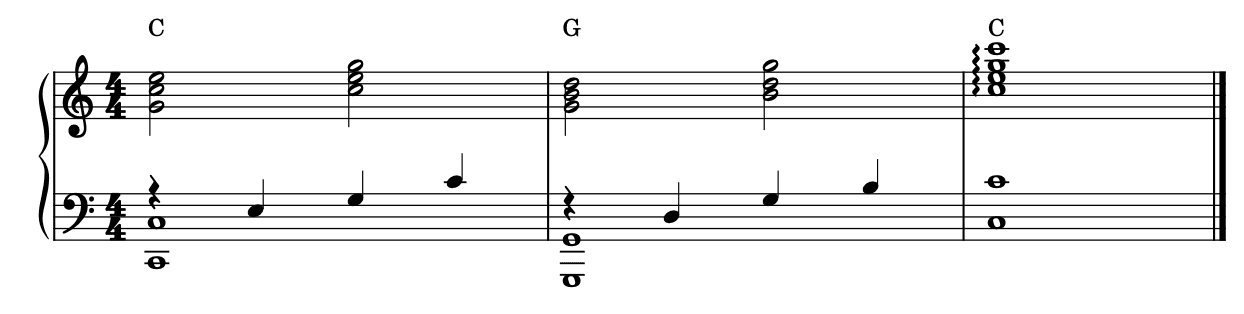
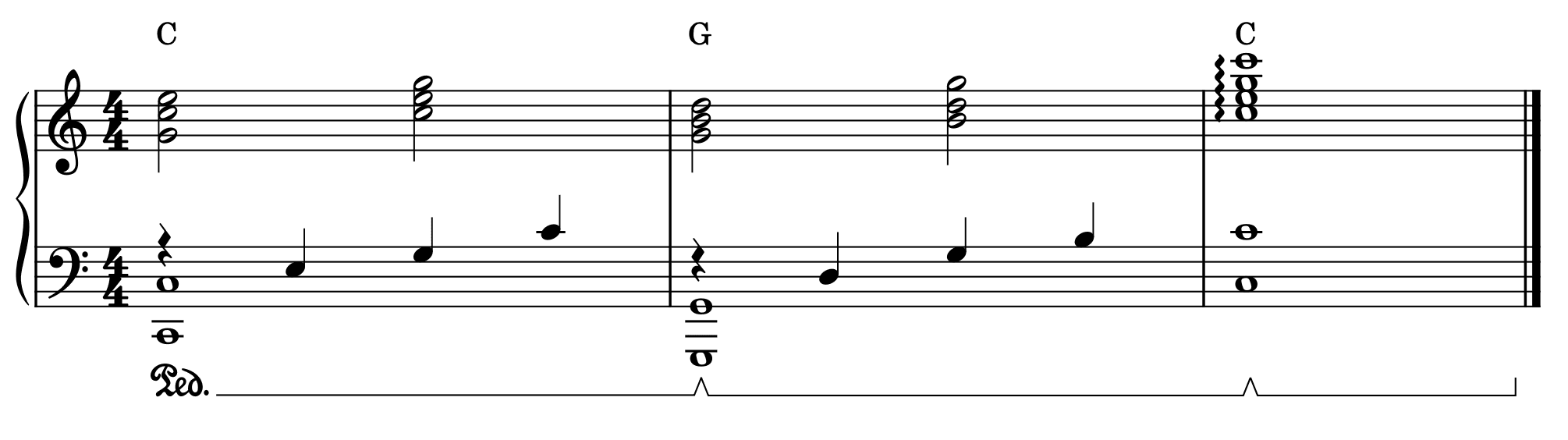
For players with more experience, text instructions often work better than granular markings. A common approach: leave the first system unmarked so the player understands it's dry, introduce pedaling by chord change in the second system, reinforce that pattern in the third, then write "Ped. sim." to indicate the player should continue in the same fashion. Once the pattern is clear, the page stays clean.
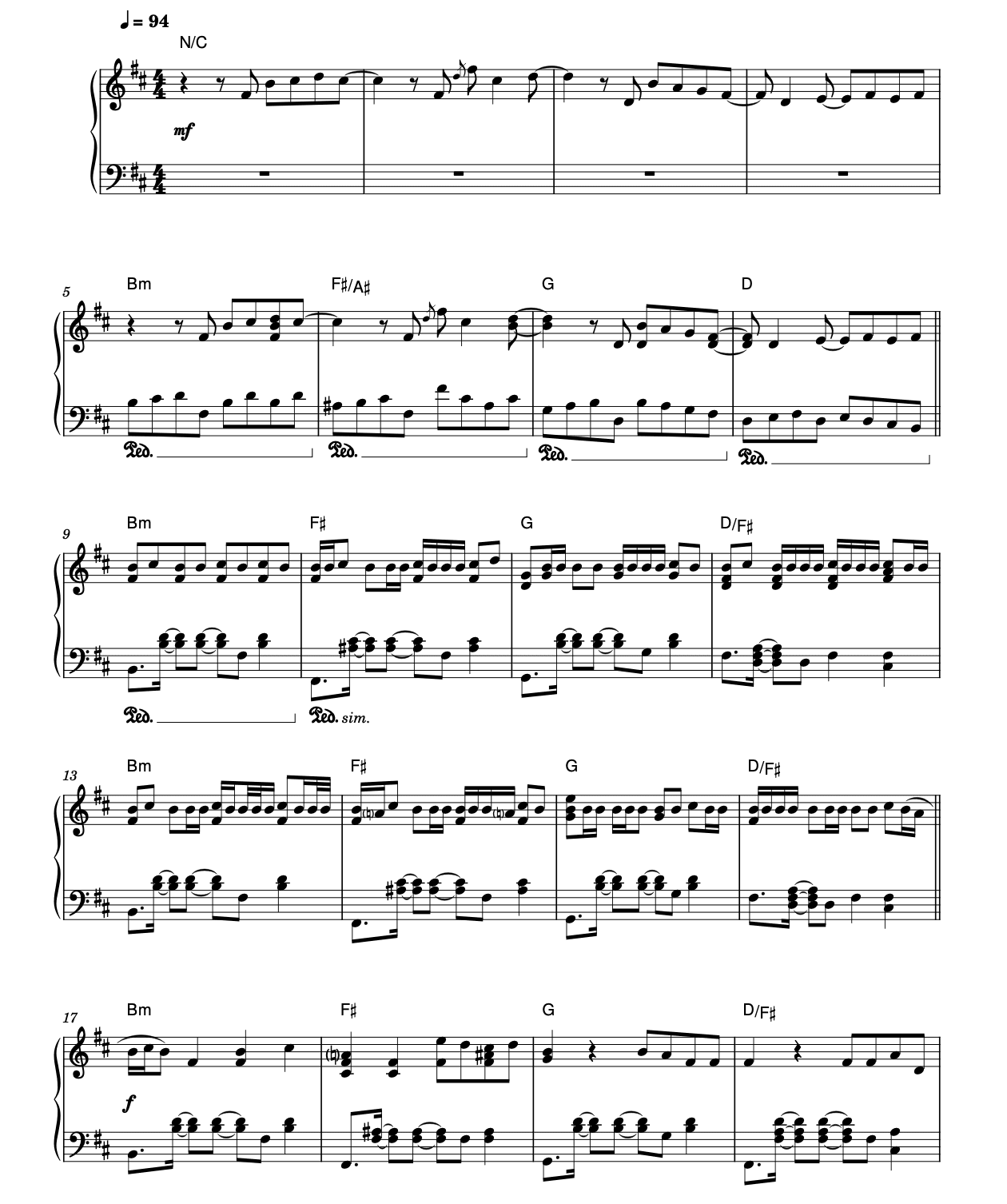
A few terms worth knowing:
- Con pedale — use the sustain pedal (without specifying exactly where)
- Senza pedale — no pedal, useful when coming out of a pedaled passage or when slurred arpeggios might otherwise suggest pedaling
- With pedal — a straightforward English alternative, increasingly common in contemporary publications
One practical note: notation software often requires pedal markings for accurate playback that you don't want printed. Be sure to hide those from the final layout.
Using Slurs
Slurs mark specific phrasing choices or draw attention to a melodic line. They can also clutter a page quickly if used indiscriminately. Modern piano performance defaults to legato, so blanketing a passage in slurs to indicate smooth playing isn't necessary as that's already the assumption.
As you work through a piece, ask periodically whether each slur is actually helping the player or just adding visual noise. Once a phrasing pattern is established, you often don't need to keep marking it.
Final Thoughts
You don't need to be a strong pianist to write good piano sheet music. A solid understanding of notation and an eye for what makes music readable will carry you further than playing ability alone.
The most useful thing you can do: study arrangements you admire. Look at what makes them clear, appropriate for their audience, and easy on the eye. Notice what works and what doesn't, and fold those observations into your own work. Style builds up over time that way from specific things you've actually noticed, not from general principles.